
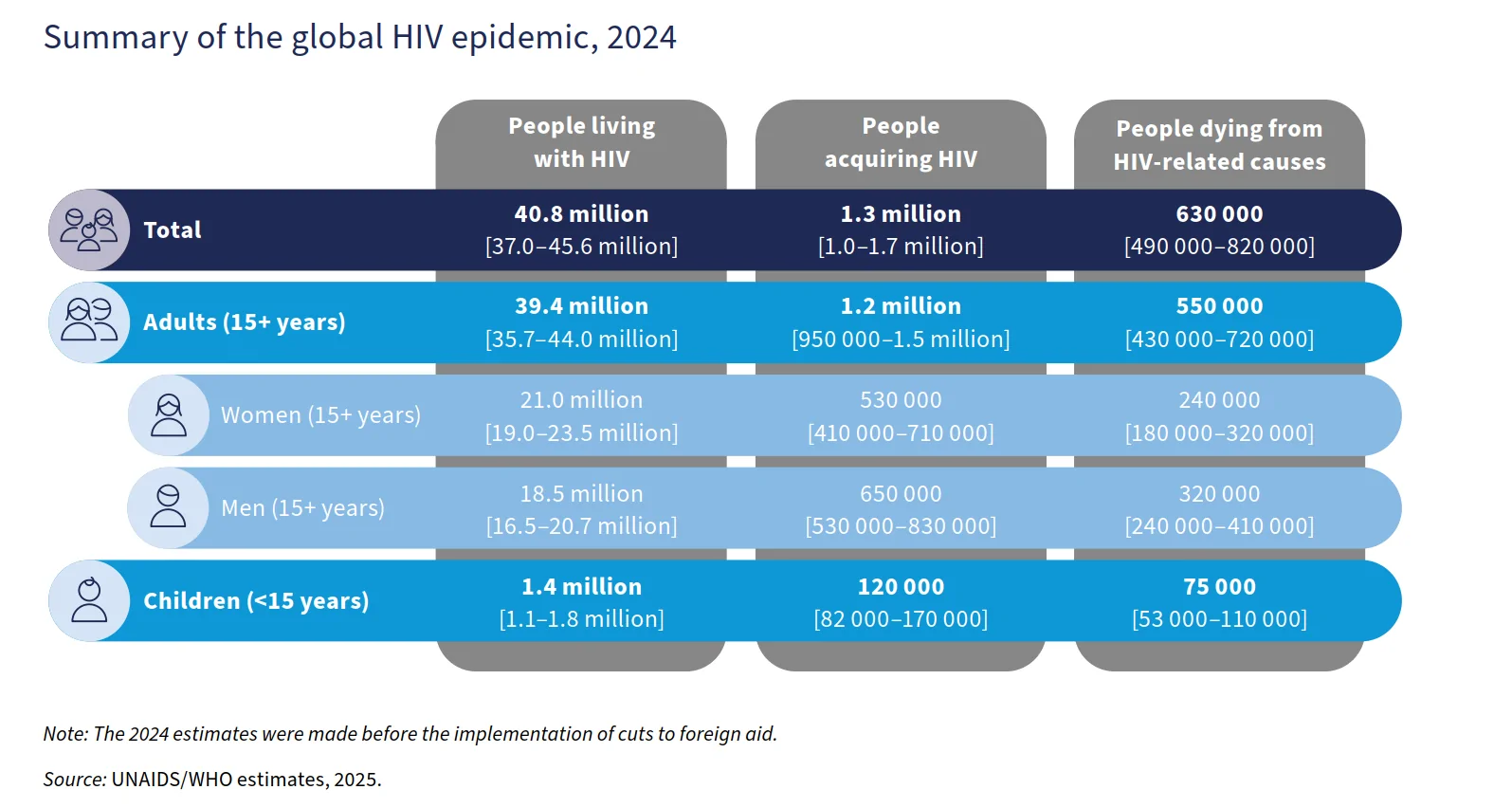
The global HIV response in 2024 reflects decades of progress but also highlights troubling gaps that threaten the path toward ending AIDS as a public health threat by 2030. Despite major achievements in prevention, treatment, and long-term survival, the world remains off-track to meet the essential targets set for 2025. An estimated 40.8 million people are living with HIV, and although infection and mortality rates have declined significantly over time, they remain unacceptably high.
The Global Burden
In 2024, approximately 40.8 million people were living with HIV, including 39.4 million adults and 1.4 million children. Since the beginning of the epidemic, more than 91 million people have acquired HIV and over 44 million have lost their lives to AIDS-related illnesses. These figures demonstrate the persistence of the epidemic and the scale of the challenge that remains, even as treatment and prevention tools have become more widely available.
Infections and Mortality Trends
HIV infections continue to decline, though progress has slowed. In 2024, about 1.3 million people acquired HIV, which represents a 40 percent reduction since 2010. Every day, roughly 3,500 adults and children become newly infected. Among children, new infections have fallen sharply since 2010, but that decline has plateaued in recent years.
AIDS-related mortality has fallen even more dramatically. In 2024, an estimated 630,000 people died from AIDS-related illnesses, which is a 54 percent decrease since 2010, and a 70 percent decline compared with the peak in 2004. Despite this progress, the number still equates to one life lost every minute. Children accounted for about 75,000 deaths recorded in 2024.
Regional Variations
HIV remains unevenly distributed across the globe, with some regions experiencing far heavier burdens than others.
Eastern and Southern Africa continue to carry the greatest share of the epidemic. The region is home to 21.1 million people living with HIV, representing more than half of the global total. In 2024, it recorded 490,000 new infections and 260,000 deaths. Although the burden remains high, the region has made some of the most significant progress worldwide, with substantial declines in both new infections and deaths since 2010. Adolescent girls and young women remain disproportionately affected.
Asia and the Pacific hold the second-largest number of people living with HIV, with 6.7 million cases. The region experienced around 300,000 new infections and 150,000 deaths in 2023. Treatment coverage remains uneven, and eight countries still report coverage rates below 50 percent.
The Americas recorded about 4.2 million people living with HIV in 2024 and 38,000 AIDS-related deaths, reflecting a steady decline in mortality since 2010.
In the WHO European Region, almost 2.6 million people are living with HIV. The situation varies sharply between western and eastern Europe. Some areas have seen a worrying 27 percent increase in HIV-related deaths, reaching 49,000 in 2023.
Across WHO regions, the African Region continues to be the most affected, with 26.3 million people living with HIV and 380,000 deaths. The South-East Asian Region reported 3.5 million cases and 50,000 deaths, while the Western Pacific Region reported 3 million cases and 83,000 deaths. In the Eastern Mediterranean Region, deaths have risen by 37 percent since 2010.
Treatment Access and Progress Toward Global Targets
Access to antiretroviral therapy has expanded dramatically over the past decade. By the end of 2024, 31.6 million people were receiving treatment, up from 7.7 million in 2010. However, the world remains short of the 34 million treatment target for 2025.
The global community has set the 95–95–95 goals to ensure that 95 percent of people living with HIV know their status, 95 percent of those diagnosed receive treatment, and 95 percent of those on treatment achieve viral suppression. In 2024, progress toward these goals was uneven.
Approximately 87 percent of people living with HIV knew their status, 89 percent of those diagnosed were on treatment, and 94 percent of those on treatment achieved viral suppression. Overall, 77 percent of all people living with HIV were accessing treatment and 73 percent were virally suppressed.
Children continue to experience the greatest disparities. Only 55 percent were receiving treatment in 2024, and fewer than half achieved viral suppression.
Gender Inequalities and Key Populations
Women and girls remain disproportionately affected by HIV, representing 53 percent of all people living with the virus. In 2024, they accounted for 45 percent of global new infections. The disparities are most visible in sub-Saharan Africa, where women and girls made up 63 percent of new infections. Every week, roughly 3,300 adolescent girls and young women in the region acquire HIV.
Key populations and their partners continue to account for more than half of all new infections globally. In Asia and the Pacific, shifts since 2010 reveal complex trends. New infections among gay men and other men who have sex with men increased by 32 percent, while infections among transgender women rose by 7 percent. In contrast, new infections among sex workers declined by 14 percent and among people who inject drugs by 35 percent. Infections among the sexual partners of key populations increased sharply, rising by 85 percent. New infections have increased in at least 32 countries since 2010.
Financing the Response
Financial investment remains a critical determinant of global progress. In 2024, approximately 18.7 billion US dollars were available for the AIDS response in low- and middle-income countries. This amount is 17 percent below what is required annually to stay on track for 2030 targets. More than half of all funding now comes from domestic sources, and 26 countries plan to increase their HIV budgets by 2026. Yet the overall shortfall continues to threaten the scale and quality of prevention, treatment, and support services.

Challenges and the Road Ahead
The world has the tools to end AIDS as a public health threat, but current progress is not fast enough. Prevention efforts have stagnated, inequalities continue to widen, and conflicts, climate-related events, and population displacement disrupt essential services. About 5.3 million people still do not know they are living with HIV, and nearly one quarter of those who know their status are not receiving treatment.
If the world fails to meet the 2025 targets, projections show that between 1.3 and 1.4 million new infections could occur in 2030, far above the goal of 200,000. If the targets are met, the number of people living with HIV could decline to around 29 million by 2050, marking a major step toward ending the epidemic.
Conclusion
The global HIV response in 2024 demonstrates both profound progress and deeply rooted challenges. The world has made enormous strides in reducing mortality, expanding treatment, and preventing new infections. Yet the epidemic continues to be fueled by inequality, insufficient resources, and gaps in access to essential services. Achieving the 2030 goal will require renewed commitment, greater investment, and a focus on the populations and regions that have been left behind. The decisions made today will determine whether the world finally moves toward ending AIDS or risks reversing decades of hard-won progress.
References